Dwyer GSTA-C Carbon Monoxide Sensor — The Ultimate Gas Monitoring Solution for Basements and Plant Rooms
[IMAGE: Dwyer GSTA-C carbon monoxide sensor mounted on a concrete column in an underground parking garage — alt text: "Dwyer GSTA-C carbon monoxide sensor monitoring basement air quality"]
In enclosed spaces such as commercial underground parking garages, diesel generator rooms, or indoor facilities utilizing combustion-engine forklifts, the accumulation of Carbon Monoxide (CO) poses a severe and potentially fatal asphyxiation risk. To ensure compliance with strict building safety codes and to optimize electrical energy consumption for ventilation systems, the Dwyer GSTA-C carbon monoxide sensor serves as the core technical solution. It enables the DDC/BMS to automatically activate exhaust fans based on real-time gas concentrations, an approach known as Demand Controlled Ventilation (DCV).
What is the Dwyer GSTA-C Carbon Monoxide Sensor?
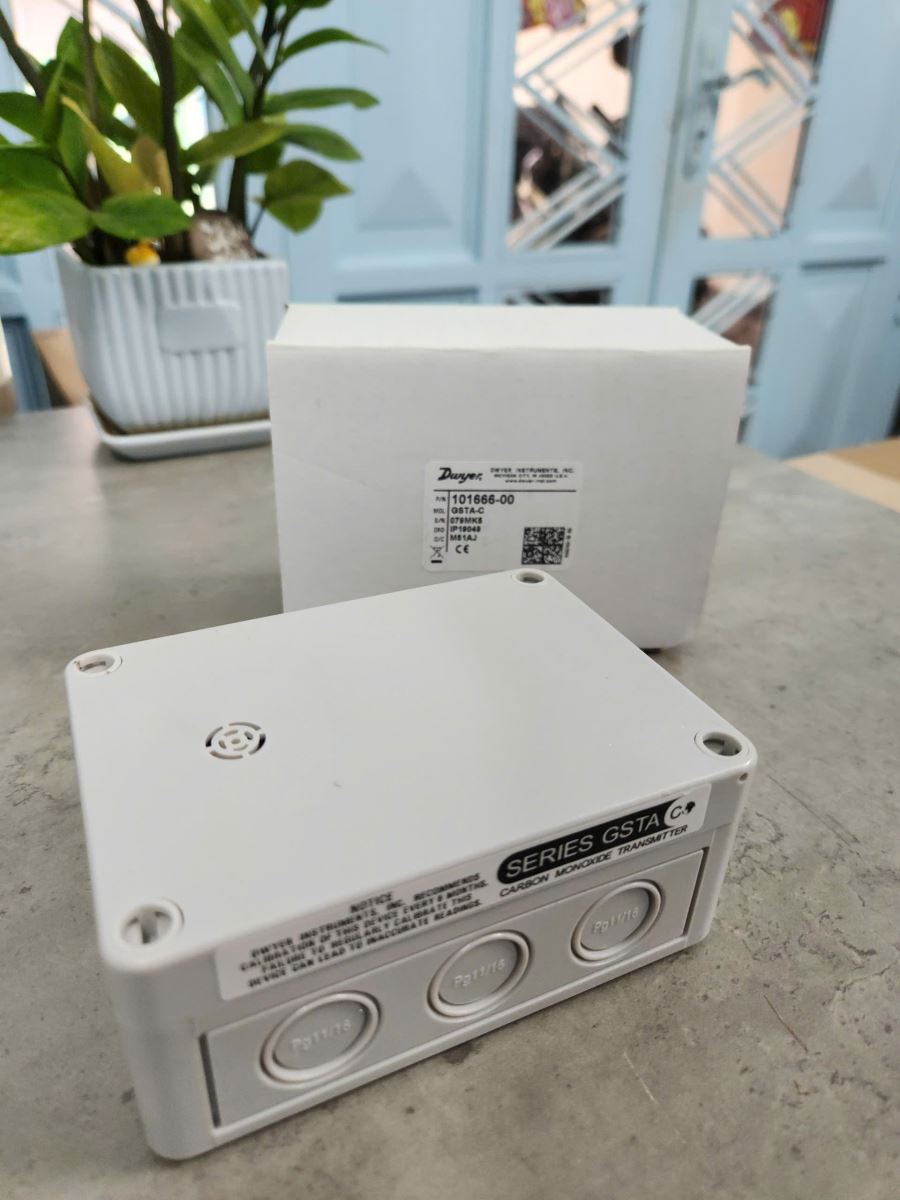
The Dwyer GSTA-C CO sensor is an industrial gas transmitter that operates on the electrochemical principle. Unlike photoelectric smoke detectors used in fire alarm systems, the sensing element of the GSTA-C contains a specific chemical electrode membrane. When CO molecules come into contact with this membrane, an oxidation-reduction reaction immediately occurs, generating a micro-current whose intensity is strictly proportional to the ambient CO concentration.
The integrated microprocessor circuit receives this current, compensates for temperature variations, and amplifies it into a standard industrial signal of 4–20mA or 0–10V DC. Thanks to this continuous linear analog signal, the BMS can establish precise, multi-tiered control logic: running fans at low speed when CO reaches 35 ppm (OSHA warning threshold), and activating fans at maximum capacity along with evacuation sirens when the concentration hits the critical 200 ppm threshold.
Model Details
GSTA-C — Standard Range 0–200 ppm
This is the dedicated Carbon Monoxide model within Dwyer's GSTA series. Featuring a robust, industrial-grade wall-mount design, the GSTA-C provides a flexible analog output signal configurable via internal DIP switches. This allows MEP engineers to easily interface the device with the Analog Input (AI) card of any central DDC controller.
Suitable for: Underground parking garages in residential and commercial buildings, diesel generator rooms, vehicle maintenance depots, and enclosed loading docks.
System Design and Selection Guide
To ensure a CO monitoring system operates accurately and meets design standards, the design engineer must address two critical technical calculations:
-
What is the required sensor density and distribution?
According to ventilation design standards for parking garages, a single CO sensor provides an effective coverage area of 200m² to 400m² of floor space (depending on the airflow patterns).
Practical Example: In an underground parking facility with a floor area of 1500m², applying a safe design metric of 300m² per sensor dictates a minimum requirement of 5 GSTA-C devices. These sensors must be evenly distributed across the parking zones, heavily prioritizing up/down ramps where vehicle acceleration causes higher emission rates.
-
Which output signal standard is appropriate for the DDC panel?
In basement environments, signal cables often traverse long distances (frequently exceeding 50m) and are subjected to severe electromagnetic interference (EMI) from the power cables of Jet Fans and VFDs. Therefore, the installation engineer must configure the GSTA-C output to a 4–20mA current loop (rather than 0–10V voltage) and utilize shielded twisted pair cables grounded at one end (at the BMS panel) to guarantee signal integrity.
General Technical Specifications
|
Specification |
Standard Value |
|
Measurement Principle |
Electrochemical |
|
Target Gas |
Carbon Monoxide (CO) |
|
Measuring Range |
0 – 200 ppm |
|
Sensor Cell Life |
2 – 5 years (depending on environmental conditions) |
|
Output Signal |
4–20mA (2-wire) or 0–10V / 2–10V DC (3-wire) |
|
Power Supply |
24V AC/DC |
|
Coverage Area |
~ 200 – 400 m² per unit |
|
Mounting Method |
Wall or concrete column mount |
|
Origin / Brand |
Dwyer Instruments (USA) |
Crucial Installation Notes
Improper installation of toxic gas sensors will render the entire warning system useless. Engineers must strictly avoid the following common errors:
Incorrect Mounting Height: Because Carbon Monoxide has a vapor density roughly equal to that of air, it mixes evenly throughout the space rather than stratifying. Standard practice dictates that CO sensors must be mounted on columns or walls at a height of 1.0m to 1.5m from the finished floor—aligning with the human breathing zone. Mounting the device at the ceiling (confusing it with smoke detectors) or near the floor (confusing it with LPG sensors) will cause the DDC to collect inaccurate data regarding the air occupants are actually breathing.
Mounting Too Close to Supply Air Diffusers: Installing the GSTA-C directly beneath or adjacent to a fresh air supply grille forces clean air directly into the sensor chamber. This airflow causes a localized dilution effect, prompting the sensor to send a "safe" signal to the BMS, while other blind spots in the basement may have already accumulated CO well beyond the 200 ppm danger threshold.
No Electrochemical Cell Replacement Plan: The measuring element of the GSTA-C relies on consumable chemical reactions within the electrochemical cell. Typically, after 2 to 5 years, the electrolyte depletes, leading to severe zero-drift and loss of sensitivity. Maintenance contractors must periodically test the devices using calibration gas and proactively replace the sensing elements when they reach the end of their operational lifespan.
Why Choose DLK TRADING AND SERVICE COMPANY LIMITED?
-
Genuine Dwyer (USA) Products: We provide complete, original Certificates of Origin (CO) and Certificates of Quality (CQ), meeting the most stringent material approval workflows of project investors.
-
Deep MEP Technical Expertise: Our engineering team directly supports equipment distribution calculations and advises on exact installation elevations and locations in accordance with ASHRAE standards.
-
BMS Integration Support: We supply comprehensive documentation and guide contractors on wiring 4-20mA analog loops for seamless integration into AI cards of major DDC platforms like Siemens, Schneider, and Honeywell.
-
Fast and Reliable Delivery: With ready stock in Ho Chi Minh City and nationwide shipping capabilities, we keep pace with the demanding construction schedules of MEP contractors.
View Model Details
Contact DLK TRADING AND SERVICE COMPANY LIMITED: 070 357 0101 | info@dlk.com.vn | https://dlk.com.vn/