Dwyer Magnehelic® 2000-750PA Differential Pressure Gage – High Sensitivity for Low Differential Pressures
Posted on: 13/07/2026
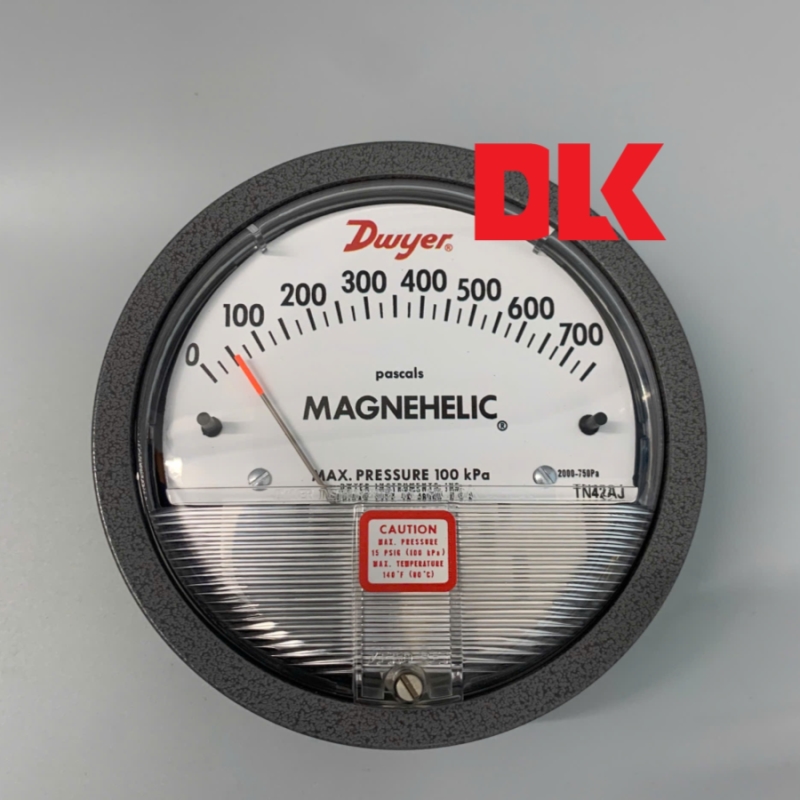
Many applications, such as cleanrooms, hospital isolation rooms, or HEPA filtration systems, require measuring instruments with exceptionally high sensitivity at low differential pressure ranges. The model 2000-750PA belonging to Dwyer's Magnehelic® Series 2000, with a maximum scale of 750 Pa, is specifically engineered to precisely meet these stringent
Advantages of the 2000-750PA Model
With a low full-scale range of 750 Pa, the 2000-750PA allows users to read minute differential pressure fluctuations clearly and accurately—details that gages with larger scales fail to display effectively. Utilizing the power-free Magnehelic® technology, the product delivers long-term stable operation and minimizes maintenance costs.
Technical Specifications
|
Specifications |
Details |
|
Product Line |
2000-750PA (Magnehelic® Series 2000) |
|
Manufacturer |
Dwyer (DwyerOmega) – American Brand |
|
Compatible Media |
Air and compatible, non-combustible gases |
|
Accuracy |
±2% of full scale @ 70°F (21.1°C) |
|
Pressure Limits |
-20 inHg to 15 psig (-0.677 to 1.034 bar) |
|
Temperature Limits |
20 to 140°F (-6.67 to 60°C) |
|
Dial Size |
4" (101.6 mm) diameter |
|
Process Connections |
Dual 1/8" female NPT taps (high and low pressure) |
|
Weight |
1 lb 2 oz (510 g) |
|
Certifications |
RoHS, CE, ATEX, UKCA |
|
Warranty |
12 months (optional upgrade to 36 months) |
Installation and User Guide:
The 2000-750PA pressure gage is a mechanical device. While its installation and calibration are quite straightforward, correct positioning and proper execution must be followed to ensure measurement accuracy, which is particularly vital for low-scale ranges like this model.
-
Select an installation location where the gage face remains in a vertical position—this is the standard position required to guarantee the manufacturer-stated ±2% accuracy. With a low range of 750 Pa, mounting position deviations affect the readings much more significantly compared to high-range models.
-
Identify the High-pressure and Low-pressure ports on the gage body—typically clearly marked on the housing or indicated in the accompanying technical documentation.
-
Connect the pressure signal tubing (flexible plastic tubing or small copper pipes) from the measurement point on the air duct/equipment to the corresponding High and Low ports, ensuring zero leakage at the connectors.
-
Before commissioning, check and adjust the pointer to the exact "0" position using the zero-adjustment screw on the front cover (when both ports are open to the atmosphere without differential pressure).
-
Apply pressure to the system and observe the pointer on the dial face to read the actual differential pressure value.
-
Periodically clean the glass cover and recheck the zero point (approximately once every 6–12 months) to maintain long-term accuracy, which is critical for high-reliability applications like cleanrooms and isolation rooms.
Note: Due to the highly sensitive 750 Pa scale, avoid installing the device near doorways or areas exposed to direct drafts, as this can cause pointer oscillation and temporary reading deviations.
Practical Applications
-
Monitoring differential pressure in ISO-standard cleanrooms within the pharmaceutical and electronics industries.Tracking the performance of high-capacity centrifugal fans in manufacturing plants.
-
Controlling negative/positive pressure in hospital isolation rooms.
-
Tracking the loading and clogging status of HEPA and fine filters in air handling systems.
-
Integrating into laboratory environments that mandate strict airflow control.
Why Buy the 2000 - 750PA at DLK?
-
Genuine Dwyer products directly imported with full CO/CQ documentation.
-
In-depth technical consultation tailored for low differential pressure and high-accuracy applications.
-
Comprehensive provisioning of catalogs, manuals, and datasheets required for project submittals.
-
Transparent warranty policy and dedicated technical support.
Contact DLK for Consultation & Quotation :